NoteWander pick
Japan in 10 Days: Cherry Blossoms from Tokyo to Kyoto, Nara and Osaka
Tokyo, Hakone, Kyoto, Nara and Osaka, Japan · 10 days · Cultural Explorer, Foodie
Trip overview
Ten days riding the cherry-blossom front through Japan's classic route: neon Tokyo, a hot-spring night in Hakone, temple-filled Kyoto, Nara's deer and Osaka's street food.
Highlights
- Hanami under the cherry trees of Ueno Park and Chidorigafuchi moat
- Sunset over Shibuya Crossing from the Shibuya Sky rooftop
- A ryokan night with an onsen bath in Hakone and the torii gate on Lake Ashi
- Dawn among the vermilion gates of Fushimi Inari before the crowds
- The weeping cherry of Maruyama Park and lantern-lit Gion Shirakawa
- Bowing deer and the giant bronze Buddha of Tōdai-ji in Nara
- The Philosopher's Path in full bloom
- Kuromon Market and kushikatsu in retro Shinsekai, Osaka
Why this plan
The route runs west with the train line, so you never backtrack: Tokyo first, a night in Hakone on the way, then Kyoto, with Nara as a day trip and Osaka last for its airport. Early April is usually peak bloom in both Tokyo and Kyoto, and the order avoids weekly closures: the Imperial Palace East Gardens (closed Mondays and Fridays) fall on a Tuesday, Tsukiji is visited on a weekday, Junsei is booked for Tuesday (it closes on Wednesdays) and Nara's day is spent at temples and shrines that open on Mondays.
Pace
Expect 15,000–25,000 steps a day and early starts, which are the only way to enjoy the famous sights in cherry-blossom season. Days 4–5 and 9 include travel, so luggage forwarding makes them much easier.
Daily Itinerary
Day 1: Asakusa, the Sumida and Ueno blossoms
Start early at Sensō-ji, Tokyo's oldest temple, walking in through the Kaminarimon gate before the Nakamise shopping street fills up. Stroll down to Sumida Park, where cherry trees line the river with Tokyo Skytree behind them. Queue for a tempura bowl at Daikokuya, then take the Ginza line three stops to Ueno Park for an afternoon of hanami among the picnic crowds. Finish browsing the market stalls of Ameyoko and eat at an izakaya under the railway tracks.
Stops
08:00Sensō-ji · Asakusa
75 min · free
Tokyo's oldest temple, with the giant red lantern of Kaminarimon and a five-storey pagoda.
The main hall opens at 06:00; the shops on Nakamise open around 09:00, so come early for photos.
09:30Sumida Park · Asakusa
45 min · free
Hundreds of cherry trees line both banks of the Sumida River, framed by Tokyo Skytree.
Walk the west bank north from Azumabashi bridge for the classic Skytree-and-blossom view.
11:00Daikokuya Tempura · Asakusa
60 min · about ¥2,000–¥2,500
An Asakusa institution since 1887, known for dark, sesame-oil tempura over rice.
Join the queue before it opens; it moves quickly.
13:15Ueno Park · Ueno
150 min · free
Tokyo's most famous hanami spot, with an avenue of more than 800 cherry trees and temples around Shinobazu Pond.
Walk past the picnic tarps to Shinobazu Pond and Bentendō hall for quieter blossom views.
16:15Ameyoko · Ueno
75 min · free to browse
A lively post-war market street under the JR tracks, full of snacks, fruit stalls and dried seafood.
Stay for dinner at one of the standing izakaya under the railway arches.
Onigiri and coffee from a konbini · Daikokuya Tempura · Yakitori at an Ameyoko izakaya · Ningyo-yaki cakes on Nakamise · Sakura-flavoured treats in Ueno
Day 2: Tsukiji, Hamarikyu and the palace moat
Eat your way through the Tsukiji Outer Market for breakfast, then walk ten minutes to Hama-rikyū, a former shōgun's garden where you can sip matcha in a teahouse on the pond. Ride the metro to Ōtemachi and walk the stone walls and lawns of the Imperial Palace East Gardens, which are closed on Mondays and Fridays. Continue round the moat to Chidorigafuchi, one of Tokyo's loveliest cherry-blossom walks, and stay as the trees are lit up after dark.
Stops
08:00Tsukiji Outer Market · Tsukiji
90 min · about ¥2,000–¥4,000
The old fish market's outer streets still have hundreds of stalls selling seafood, knives and street snacks.
Eat at the stall where you buy; walking while eating is frowned upon.
10:00Hama-rikyū Gardens · Shiodome
75 min · ¥300
A tidal Edo-period garden with a teahouse on an island, set against modern skyscrapers.
Order matcha and a wagashi sweet at Nakajima-no-ochaya (about ¥1,000).
13:00Imperial Palace East Gardens · Chiyoda
90 min · free
The huge stone foundations of Edo Castle's keep, surrounded by manicured lawns and seasonal flowers.
Enter by the Ōtemon gate and climb the old keep foundations for the view.
15:30Chidorigafuchi · Kudanshita
150 min · free; rowing boats about ¥800 per 30 minutes
A 700 m path along the palace moat under arching cherry trees, with rowing boats below.
Boat queues can top an hour at peak bloom; walk the path first and decide.
Tsukiji Outer Market · Ramen or a bento from Tokyo Station · Izakaya around Kudanshita or Kagurazaka · Matcha at Hama-rikyū teahouse
Day 3: Shinjuku Gyoen, Meiji Jingu and Shibuya
Spend the morning in Shinjuku Gyoen, whose many cherry varieties give the longest blossom season in Tokyo. Take the train one stop to Harajuku for the forested approach to Meiji Jingu, then dive into the youth fashion of Takeshita Street. Walk down Omotesandō to lunch on tonkatsu at Maisen, then continue to Shibuya for a sunset slot on the Shibuya Sky rooftop above the famous scramble crossing. In the evening, head back to Shinjuku's tiny yakitori alleys.
Stops
09:00Shinjuku Gyoen · Shinjuku
120 min · ¥500
A vast former imperial garden with more than 60 cherry varieties and English, French and Japanese landscapes.
Enter by the Shinjuku gate at opening and head for the Japanese garden first.
11:30Meiji Jingu · Harajuku
60 min · free
A serene Shinto shrine to Emperor Meiji, reached through a forest of 100,000 trees.
Look for the wall of sake barrels on the main approach.
12:45Takeshita Street · Harajuku
30 min · free
Tokyo's pop-culture shopping lane of crêpe stands, vintage clothes and kawaii fashion.
Turn into the quieter Cat Street afterwards for independent boutiques.
13:30Maisen Aoyama · Omotesandō
60 min · about ¥1,800–¥3,500
Tokyo's best-known tonkatsu restaurant, set in a converted public bathhouse.
The lunch sets are the best value; refills of rice, cabbage and miso soup are free.
16:45Shibuya Sky · Shibuya
90 min · about ¥2,500–¥3,500 online
An open-air rooftop 229 m above Shibuya, looking down on the scramble crossing and out to Mount Fuji on clear days.
Lockers are mandatory for bags; arrive 15 minutes before your slot.
Bakery breakfast near Shinjuku station · Maisen Aoyama · Yakitori in Omoide Yokochō · A crêpe on Takeshita Street
Day 4: Hakone: art, sulphur and Lake Ashi
Take the Odakyu Romancecar from Shinjuku to Hakone-Yumoto, having sent your big bags ahead to Kyoto. Ride the switchback Tozan railway up to the Hakone Open-Air Museum, where sculptures stand among the hills. Continue by cable car and ropeway over the steaming vents of Ōwakudani to eat black eggs cooked in the hot springs, then glide down to Lake Ashi for the boat to Moto-Hakone. Finish at Hakone Shrine's lakeside torii before checking into your ryokan for an onsen and kaiseki dinner.
Stops
09:00Hakone-Yumoto Station · Hakone-Yumoto
20 min · Freepass about ¥6,100 from Shinjuku plus about ¥1,200 Romancecar fee
The gateway to Hakone, where the mountain railway begins its zigzag climb.
Sit on the left of the Tozan train for the best valley views.
10:15Hakone Open-Air Museum · Ninotaira
120 min · about ¥2,000
Monumental sculptures by Rodin, Moore and others set across a hillside, plus a Picasso pavilion.
Soak your feet in the free hot-spring foot bath inside the grounds.
13:00Ōwakudani · Ōwakudani
60 min · about ¥500 for a bag of eggs
A volcanic valley of sulphur vents, with Mount Fuji on the horizon on clear days.
People with asthma or heart conditions should limit time here because of the gas.
14:30Lake Ashi sightseeing cruise · Lake Ashi
40 min · included in Freepass
A replica pirate ship crosses the crater lake from Tōgendai to Moto-Hakone.
Stand on the open deck at the stern for views back towards Fuji.
15:30Hakone Shrine · Moto-Hakone
60 min · free
A shrine in towering cedars with a red 'peace' torii standing in the lake.
The queue for the lakeside torii photo can be long; the view from the shore path is just as good.
Ekiben (station bento) on the Romancecar · Black eggs and snacks at Ōwakudani · Kaiseki dinner at your ryokan · Coffee at the Open-Air Museum café
Day 5: Old Tōkaidō teahouse to Kyoto's Gion
After a ryokan breakfast and a last soak, take the bus to Amazake-chaya, a thatched teahouse on the Old Tōkaidō road that has served travellers for about 400 years. Continue by bus to Odawara for the Hikari Shinkansen to Kyoto, about two hours west. After checking in, walk the willow-lined canal of Gion Shirakawa and up through Yasaka Shrine to Maruyama Park, whose giant weeping cherry is lit up after dark. Have dinner in Gion or along the Kamo River.
Stops
09:00Amazake-chaya · Old Tōkaidō, Hakone
45 min · about ¥500–¥1,000
A thatched Edo-period teahouse still run by the same family, serving sweet rice drinks to walkers.
Walk a short stretch of the stone-paved Old Tōkaidō trail nearby.
11:00Odawara Station · Odawara
150 min · about ¥12,000 reserved seat to Kyoto
The nearest Shinkansen stop to Hakone, served by Hikari trains to Kyoto.
Sit on the right-hand side (seat E) heading west for a chance of seeing Mount Fuji.
15:30Gion Shirakawa · Gion
45 min · free
Kyoto's prettiest canal street, with wooden teahouses and cherry trees trailing into the water.
Many Gion lanes are private; follow the signs and never photograph geiko without permission.
16:30Yasaka Shrine · Gion
30 min · free
Gion's guardian shrine, with a dance stage hung with hundreds of lanterns.
Come back after dark when the lanterns are lit.
17:15Maruyama Park · Higashiyama
75 min · free
Kyoto's classic hanami park, centred on a huge illuminated weeping cherry.
The food stalls here are fun, but the lawns are packed after 18:00.
Japanese breakfast at the ryokan · Ekiben on the Shinkansen · Obanzai (Kyoto home cooking) in Gion · Amazake at Amazake-chaya · Yatai snacks in Maruyama Park
Day 6: Fushimi Inari and Higashiyama slopes
Be at Fushimi Inari by 07:00 to climb through thousands of vermilion torii while the paths are calm; the Yotsutsuji crossing, about 40 minutes up, has a fine view over Kyoto. Take the train back north and walk up to Kiyomizu-dera, whose wooden terrace hangs over a sea of blossoms. Wander down the stepped lanes of Sannenzaka and Ninenzaka, then ride to Nishiki Market for a grazing lunch. After a rest, spend the evening in lantern-lit Pontochō by the Kamo River.
Stops
07:00Fushimi Inari Taisha · Fushimi
120 min · free
The head shrine of Inari, with tunnels of torii climbing Mount Inari.
The crowds thin after the first 15 minutes of the climb; turn back at Yotsutsuji if short of time.
10:00Kiyomizu-dera · Higashiyama
75 min · ¥500
A UNESCO-listed temple whose wooden stage stands on 13 m pillars above the blossoms.
Walk down to the Otowa waterfall and the pagoda viewpoint on the far side.
11:30Sannenzaka and Ninenzaka · Higashiyama
45 min · free
Preserved stone-stepped lanes of wooden shops leading down towards the Yasaka pagoda.
Look back up Yasaka-dōri for the classic pagoda photo.
13:00Nishiki Market · Central Kyoto
75 min · about ¥2,000–¥3,500
A 400 m covered market known as Kyoto's kitchen, with stalls dating back centuries.
Eat at each stall rather than walking with food.
18:00Pontochō · Pontochō
120 min · dinner about ¥4,000–¥10,000
A narrow lantern-lit alley of restaurants and teahouses beside the Kamo River.
Look for menus posted outside; many places have set dinners at clear prices.
Konbini breakfast before Fushimi Inari · Nishiki Market · Set dinner in Pontochō · Kitsune udon or inari-zushi near Fushimi Inari · Matcha soft-serve in Higashiyama
Day 7: Arashiyama bamboo and the Golden Pavilion
Take an early JR train to Saga-Arashiyama and walk the bamboo grove at 07:30, while it is still quiet. Visit the Zen garden of Tenryū-ji when it opens at 08:30, then wander down to the Katsura River and Togetsukyō bridge, backed by blossom-covered hills. Lunch on soba with a river view at Arashiyama Yoshimura, then take a bus or taxi to Kinkaku-ji, whose gold-leaf pavilion glows over its mirror pond in the afternoon light.
Stops
07:30Arashiyama Bamboo Grove · Arashiyama
40 min · free
A path through towering green bamboo that creaks and whispers in the wind.
Walk on up to the Ōkōchi Sansō villa end, where it is quietest.
08:30Tenryū-ji · Arashiyama
75 min · ¥500 garden, plus ¥300 for the halls
A UNESCO-listed Zen temple with a 14th-century pond garden that borrows the hills as scenery.
Leave by the north gate, which opens straight onto the bamboo grove.
10:15Togetsukyō Bridge · Arashiyama
45 min · free
Arashiyama's landmark bridge, framed by hills dotted with wild cherry trees.
Rent a rowing boat on the upstream side for a different angle.
11:15Arashiyama Yoshimura · Arashiyama
60 min · about ¥1,500–¥2,500
A long-running soba restaurant with big windows over the river and bridge.
Ask for a window seat upstairs; arrive at opening to avoid a wait.
13:45Kinkaku-ji · Kita
60 min · ¥500
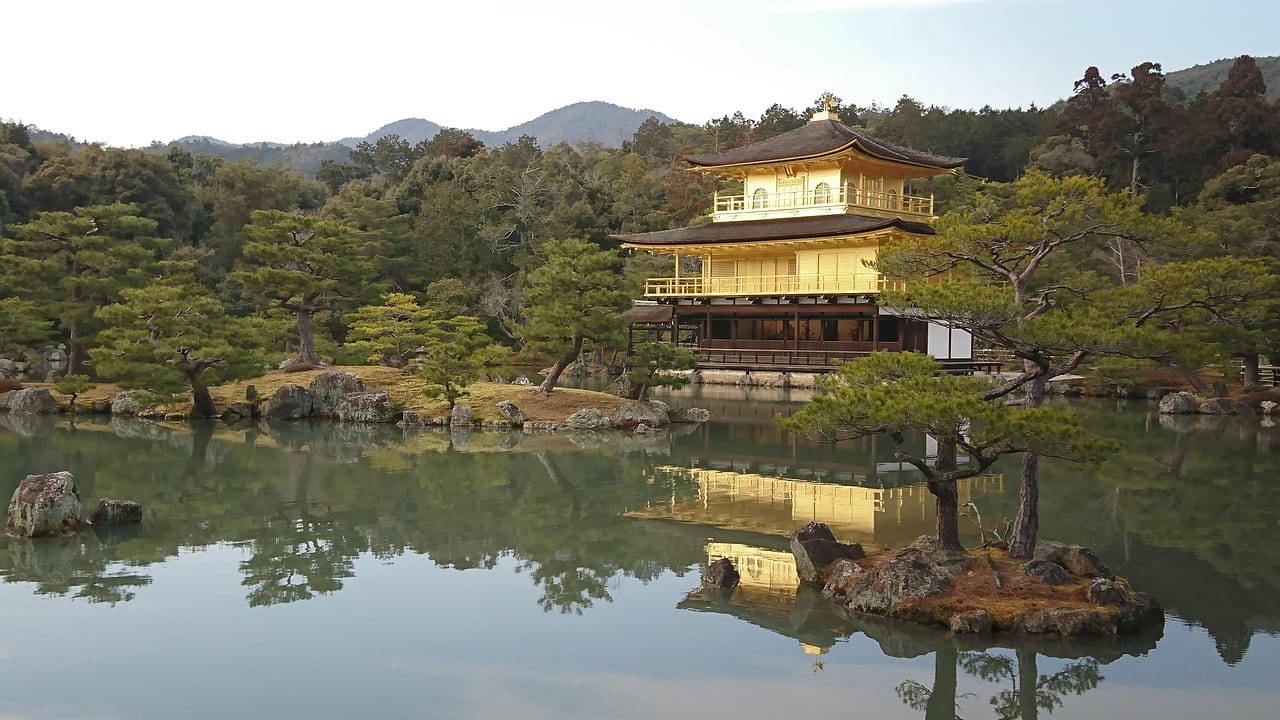
The Golden Pavilion, a gold-leaf-covered temple reflected in a mirror pond.
The best photo is in the first few minutes of the one-way route, so do not rush past it.
Bakery breakfast before the train · Arashiyama Yoshimura · Ramen near Kyoto Station · Sakura mochi and matcha soft-serve in Arashiyama
Day 8: Nara: deer, Daibutsu and old lanes
Take the Kintetsu line to Nara (about 40 minutes) and start at Kōfuku-ji, whose five-storey pagoda is under restoration until around 2031. Walk through Nara Park, where some 1,200 tame deer bow for crackers, to Tōdai-ji and its 15 m bronze Buddha inside one of the world's largest wooden buildings. Follow the stone-lantern path to Kasuga Taisha, then loop back to watch the high-speed mochi pounding at Nakatanidou. Spend the afternoon in the old merchant lanes of Naramachi before returning to Kyoto.
Stops
09:00Kōfuku-ji · Nara Park
45 min · grounds free; National Treasure Museum about ¥700
An 8th-century temple whose museum holds the famous three-faced Ashura statue.
The museum is small and rarely crowded first thing.
10:00Tōdai-ji · Nara Park
75 min · about ¥800
The Great Buddha Hall shelters a bronze Buddha cast in the 8th century.
Look for the pillar with a hole the size of the Buddha's nostril; children squeeze through it for luck.
11:45Kasuga Taisha · Nara Park
60 min · grounds free; inner area about ¥700
A vermilion shrine approached through forest lined with some 2,000 stone lanterns.
The bronze lanterns hanging in the inner corridors are the most photogenic.
13:15Nakatanidou · Sanjō-dōri
30 min · about ¥150–¥500
A mochi shop famous for its lightning-fast pounding demonstrations.
Pounding happens every so often when a crowd gathers; eat the mochi while warm.
14:00Naramachi · Naramachi
90 min · free
Lanes of preserved machiya townhouses, sake breweries and craft shops.
Look for the red monkey charms hanging from the eaves to ward off bad luck.
Coffee and pastries at Kyoto Station · Kakinoha-zushi in Nara · Izakaya in central Kyoto · Yomogi mochi at Nakatanidou
Day 9: Philosopher's Path, then on to Osaka
Start at Ginkaku-ji, the Silver Pavilion, with its raked sand garden and moss paths. Walk south along the Philosopher's Path, a 2 km canal-side lane under an unbroken tunnel of cherry blossom. End at Nanzen-ji, with its huge Sanmon gate and brick aqueduct, and have a slow yudofu lunch at Junsei. In the afternoon, collect your bags and take the train to Osaka (about 30 minutes), then spend the evening eating your way along neon-lit Dōtonbori.
Stops
08:30Ginkaku-ji · Higashiyama
60 min · ¥500
The Silver Pavilion, a refined Zen retreat with a sculpted sand cone and moss garden.
Follow the path uphill behind the pavilion for a view over Kyoto.
09:45Philosopher's Path · Higashiyama
60 min · free
A stone path along a canal lined with hundreds of cherry trees, named after a philosopher who walked it daily.
Detour to Hōnen-in, a quiet moss-covered temple just off the path.
11:00Nanzen-ji · Higashiyama
60 min · grounds free; Sanmon gate about ¥600
A major Zen temple with a massive gate and a Meiji-era brick aqueduct.
Climb the Sanmon for a view over the blossoms.
12:15Nanzenji Junsei · Nanzen-ji
75 min · about ¥3,000–¥4,500
A historic yudofu restaurant in a garden estate near Nanzen-ji, the area's tofu speciality.
The yudofu set includes sesame tofu and grilled dengaku; it is lighter than it sounds.
18:00Dōtonbori · Namba, Osaka
120 min · street food about ¥2,000–¥4,000
Osaka's canal-side food street under the giant Glico running-man sign.
Try takoyaki and okonomiyaki from several places rather than one big meal.
Coffee and toast at a Kyoto kissaten · Nanzenji Junsei · Takoyaki and okonomiyaki on Dōtonbori · Matcha at a café on the Philosopher's Path
Day 10: Osaka Castle, Kuromon and Shinsekai
Leave your bags at the hotel and start at Osaka Castle, whose moats and Nishinomaru Garden are among the city's best blossom spots. Ride the metro to Kuromon Ichiba for a market lunch of grilled seafood and fruit. In the afternoon, explore Shinsekai, a retro district built around the Tsūtenkaku tower, and eat kushikatsu where it was invented. Collect your luggage and take the Nankai line from Namba to Kansai Airport.
Stops
09:00Osaka Castle · Chūō
120 min · park free; main tower about ¥600–¥1,200
A reconstructed castle keep on massive original stone walls, ringed by about 3,000 cherry trees.
Nishinomaru Garden (small fee) has the best view of the keep over the blossoms.
11:45Kuromon Ichiba Market · Nippombashi
75 min · about ¥2,000–¥4,000
Osaka's 'kitchen', a covered market of seafood, wagyu and fruit stalls.
Prices are highest at the busiest stalls; compare a few before buying.
13:45Tsūtenkaku · Shinsekai
45 min · about ¥1,000
A retro tower at the heart of Shinsekai, a 1912 entertainment district.
Rub the soles of the Billiken statue's feet for luck.
14:45Kushikatsu Daruma Shinsekai · Shinsekai
45 min · about ¥1,500–¥2,500
The original shop of Osaka's best-known kushikatsu chain, open since 1929.
Dip each skewer in the shared sauce only once.
16:30Nankai Namba Station · Namba
45 min · about ¥1,500 Rapi:t to Kansai Airport
Direct trains run from Namba to Kansai Airport.
The Rapi:t needs a reserved seat; ordinary airport expresses do not.
Coffee and a sandwich near your hotel · Kuromon Ichiba Market · Kansai Airport food court or on your flight · Kushikatsu in Shinsekai · 551 Hōrai pork buns from Namba station
Where to stay
In Tokyo, Asakusa and Ueno suit first-timers who want atmosphere and easy airport links, while Shinjuku and Shibuya suit night owls. Book a ryokan with onsen and dinner in Gōra or by Lake Ashi for the Hakone night, then stay in Higashiyama or near Kyoto Station and finish in Namba in Osaka.
- Asakusa or Ueno (Tokyo) — traditional atmosphere, good value, airport trains
- Shinjuku or Shibuya (Tokyo) — huge transport hubs and nightlife
- Gōra or Lake Ashi (Hakone) — ryokan with private or shared onsen
- Higashiyama and Gion (Kyoto) — walk to temples at dawn
- Around Kyoto Station — easiest for Nara and Shinkansen days
- Namba (Osaka) — street food on the doorstep, direct trains to Kansai Airport
Getting around
Use an IC card for city trains and a Hakone Freepass for the loop of mountain train, cable car, ropeway and lake boat. The Shinkansen from Odawara to Kyoto takes about two hours, Nara is 35–45 minutes from Kyoto on the Kintetsu line, and Osaka is about 30 minutes away. Forward luggage ahead so that travel days are hands-free.
Flight Suggestions
Fly into Tokyo Haneda (HND), which is closest to the city, or Narita (NRT), linked by the Skyliner to Ueno in about 45 minutes. Fly home from Osaka's Kansai Airport (KIX) on an open-jaw ticket so you never have to return to Tokyo.
Budget breakdown
- Per person
- ¥300,000–¥520,000
- Estimated Cost
- About ¥300,000–¥520,000 per person, excluding international flights
- Accommodation · ¥150,000–¥280,000Nine nights per person sharing, including one ryokan night with dinner; prices peak in cherry-blossom season
- Food and drink · ¥55,000–¥95,000Konbini breakfasts, market lunches, izakaya dinners and one yudofu meal
- Trains and local transport · ¥45,000–¥60,000Romancecar and Hakone Freepass, Shinkansen Odawara–Kyoto, IC card fares, airport trains
- Sights and tickets · ¥15,000–¥25,000Temples, gardens, museum, observation decks
- Extras · ¥35,000–¥60,000Luggage forwarding, souvenirs, onsen extras, snacks
Saving tips
- Skip the 7-day JR Pass; on this route single tickets plus an IC card cost less
- Eat lunch sets (teishoku) rather than dinner menus at the same restaurants
- Konbini breakfasts (onigiri, sandwiches, coffee) cost about ¥500
- Many of the best blossom spots, shrines and temple grounds are free
Weather
Expected conditions
Late March to early April is mild but changeable, typically 14–19°C by day and 5–9°C at night, with occasional rain. Hakone is several degrees colder and can be misty.
What to wear
Dress in layers with a light down or fleece jacket for chilly mornings and evening hanami. Bring a compact umbrella and shoes that are easy to take off at temples and ryokan.
Packing Suggestions
- Slip-on walking shoes and socks without holes
- Warm layer for evening blossom viewing
- Compact umbrella
- Picnic sheet and wet wipes for hanami
- Small daypack for the Hakone night
- Coin purse for temples and lockers
- Universal adapter (Type A) and power bank
Restaurant & Cafe Picks
- Daikokuya Tempura (Asakusa) — tendon with sesame-oil-fried prawns
- Maisen Aoyama (Omotesandō) — kurobuta pork tonkatsu in a former bathhouse
- Nishiki Market (central Kyoto) — tamagoyaki, yuba and pickles stall by stall
- Nanzenji Junsei (Nanzen-ji, Kyoto) — yudofu (simmered tofu) course in a garden setting
- Kuromon Ichiba Market (Osaka) — grilled scallops and fresh sushi
- Kushikatsu Daruma (Shinsekai, Osaka) — deep-fried skewers, no double-dipping
Local tips
Etiquette
- Take shoes off where you see a step up or a shoe rack, and use the toilet slippers only in the toilet
- Keep voices low and phones on silent on trains; do not eat on local trains
- At hanami spots, take all rubbish home and never shake or pull branches
- Wash before entering an onsen; swimsuits are not worn, and large tattoos may not be allowed
Getting around
- Tap one IC card for metros, JR lines, buses and even konbini purchases in Tokyo, Kyoto and Osaka
- Forward big suitcases by takkyūbin from Tokyo to Kyoto (about ¥2,500–¥3,500 per bag, next-day delivery)
- In Kyoto, use trains and walk rather than crowded city buses during sakura season
- Hikari Shinkansen trains stop at Odawara; most Nozomi trains do not
Tourist traps to avoid
- Visiting Fushimi Inari, the bamboo grove or Kiyomizu-dera at midday; go at opening or dawn
- Restaurant touts in Shinjuku's Kabukichō and bars with hidden cover charges
- Feeding deer in Nara anything except official shika senbei crackers
Safety Notes
- Japan is very safe, but keep an eye on bags in packed sakura crowds and on station platforms
- Ōwakudani and the Hakone Ropeway close when volcanic gas levels rise; check the status that morning
- Earthquakes happen: note your hotel's evacuation route and follow staff instructions
- Crossing Shibuya and Gion streets, watch for cyclists on pavements
Good to know
- Transit
- Suica/Pasmo IC card; skip the JR Pass
- Tipping
- Not expected; never tip
- Tap water
- Safe to drink everywhere
- SIM / eSIM
- Travel eSIM or pocket Wi-Fi recommended
- Plug
- Type A, 100 V
- Sunrise / sunset
- 05:35 / 18:10
Bookings
- Hotels and a Hakone ryokan as early as possible; cherry-blossom season sells out
- Shibuya Sky timed sunset slot (released about four weeks ahead)
- Shinkansen seats from Odawara to Kyoto, plus an oversized-baggage seat if your bag is over 160 cm total
- Lunch at Nanzenji Junsei and any kaiseki dinners in Kyoto
- Check whether Shinjuku Gyoen needs a timed entry during peak bloom
Documents
- Passport valid for your whole stay (many nationalities enter visa-free for up to 90 days; check your own rules)
- Register on Visit Japan Web for faster immigration and customs
- Travel insurance that covers medical care, which is excellent but expensive
Money
- Cards work in cities, but carry ¥10,000–¥20,000 cash for shrines, markets and small restaurants
- 7-Eleven and Japan Post ATMs accept foreign cards
- Add money to a Suica in Apple Wallet or Google Wallet, or buy a physical card
Health & safety
- Bring any prescription medicine in its original packaging; some common cold medicines are banned
- Pack antihistamines if you suffer from spring pollen (cedar pollen peaks in March)
- Take a small towel and hand sanitiser; many restrooms have no paper towels
Emergency info
- Emergency number
- 110 police, 119 ambulance and fire
- Non-emergency
- Japan Visitor Hotline: 050-3816-2787 (24 hours, English)
Useful phrases
- Arigatō gozaimasu — thank you
- Sumimasen — excuse me / sorry
- Kore o kudasai — this one, please
- Eigo no menyū wa arimasu ka? — do you have an English menu?
- …wa doko desu ka? — where is…?